Immortal trees
Immortal trees
An interesting thing to ponder on is how old a tree can grow when starting from a cutting. Think about it, when you have a tree that’s hundreds of years old and then take a cutting, does the age of the donor tree matter? Will the new tree be short-lived, or can it live on to grow just as old as its parent?
Oldest trees in the world
Let’s take one step back and first grow a tree the regular way, sprouting from a seed. Starting from such a tiny package, a tree can grow for a mind-bogglingly long time. Runners-up from team broadleaf include olives and the tropical jequitibá-rosa and camphor trees, with a respectable score of over 3000 years. The oldest trees, however, are all conifers, with species of cypress, pine, yew, and sequioa in the lead. The top survivors are bristlecone pines and, possibly the oldest tree on earth, a Fitzroya cypress in Chile called Gran Abuelo, which has been around for over 5000 years, it’s older than the pyramids!
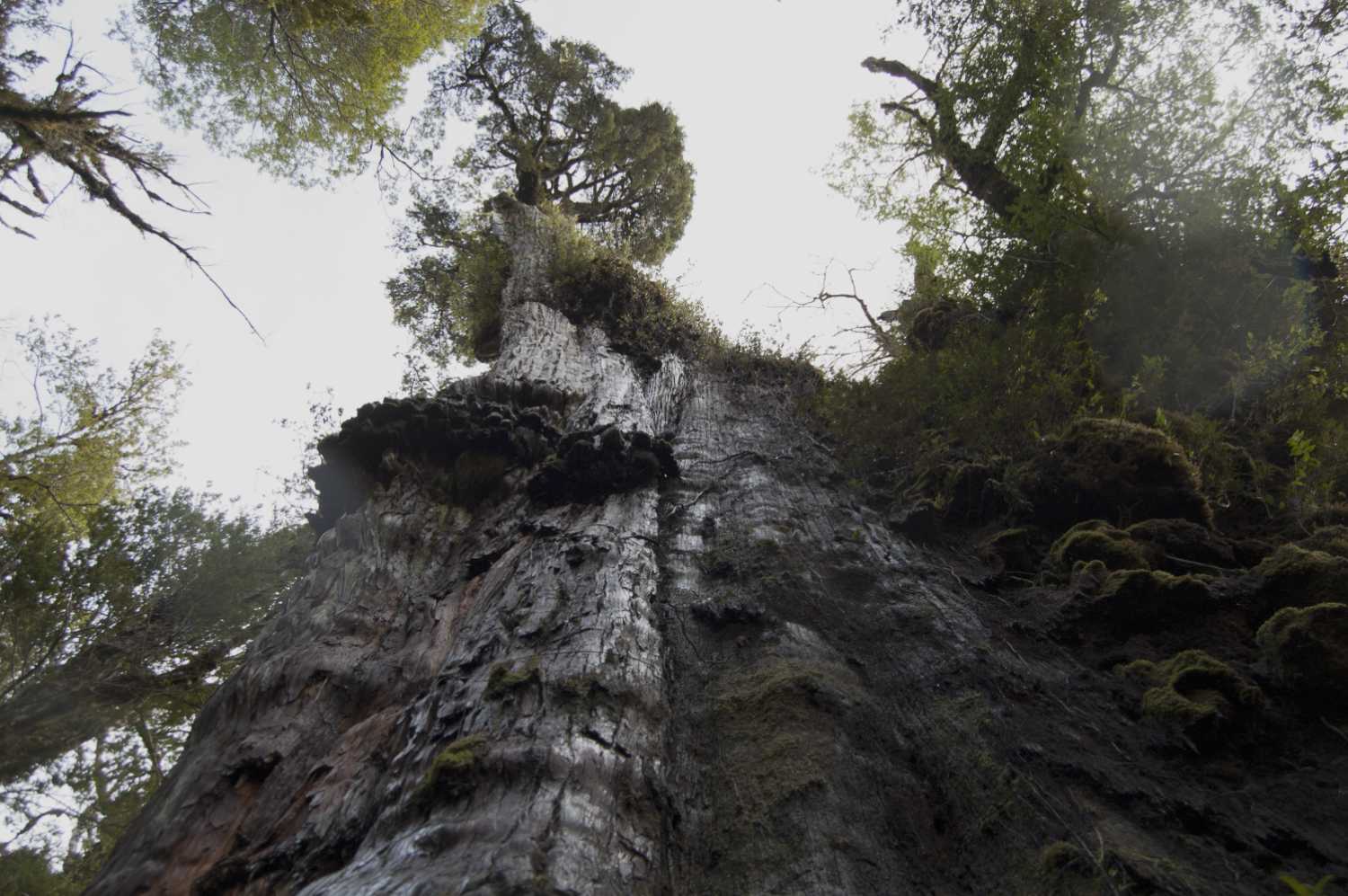
Photograph of Gran Abuelo by Gonzalo Zúñiga Solís (License: CC-BY-SA 4.0 – minor color adjustments)
It gets even more impressive when we dive below ground. After a tree is lost in flames or maybe a storm, its base and root system can survive and give rise to a new trunk. Take for example Old Tjikko, an ancient spruce tree which managed to survive the harshest weather conditions for almost 10,000 years, and counting! Can you imagine?
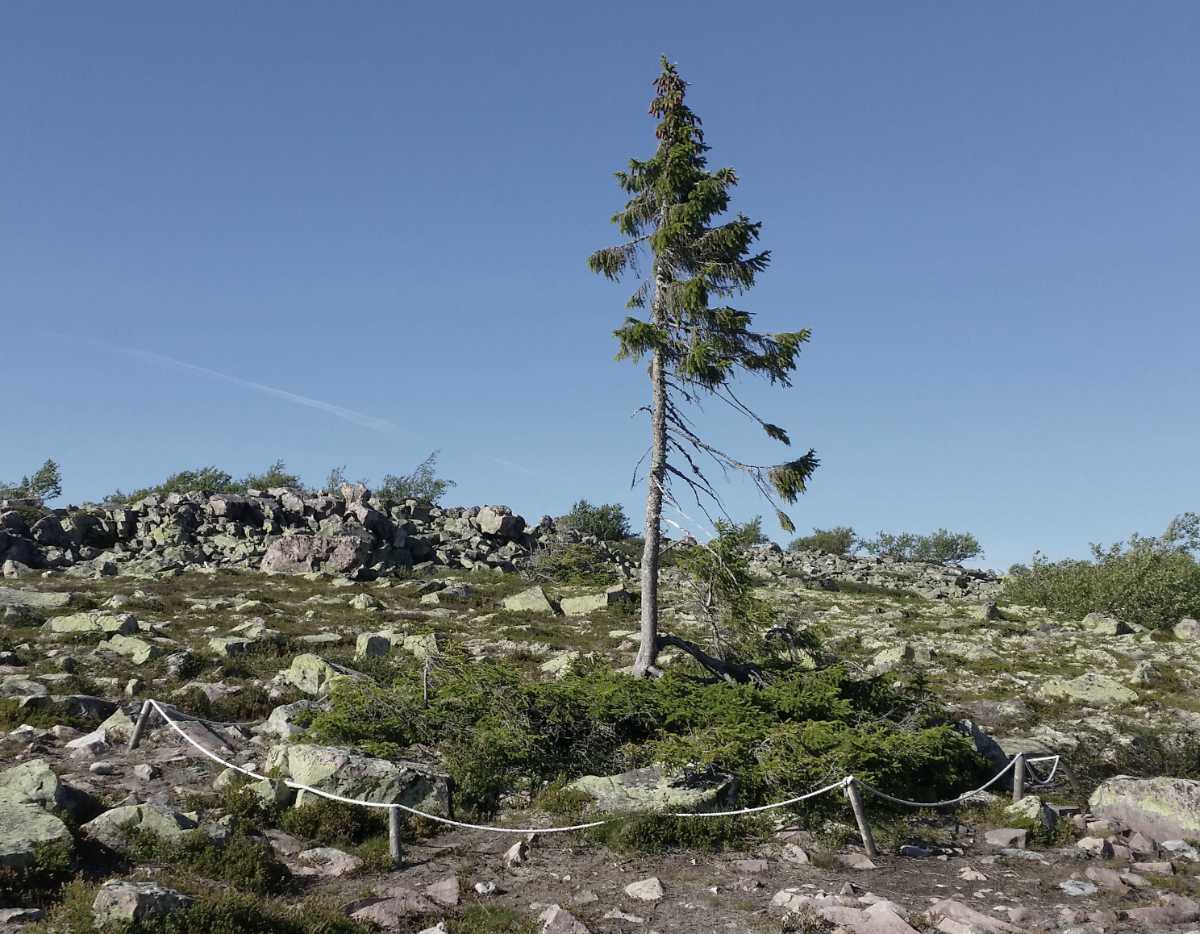
Photograph of Old Tjikko by Karl Brodowsky (License CC-BY-SA 3.0 – with minor color adjustments)
Still below ground, some trees can use their expanding root system to produce new above-ground-trees all over the place, which is just one way of vegetative reproduction. A well-known example goes by the name Pando, a large grove of aspen trees counting almost 50,000 genetically identical trunks all rising from a single root system that connects them all. Although aspen trees can also propagate “normally” by seeds, Pando is an isolated male tree with no female tree anywhere near. But that hasn’t stopped it from spreading in its isolated patch high up in Utah. There’s no easy way to determine the age of this organism – estimates vary wildly from a plausible 14,000 to an unlikely 80,000 years. Even the lower estimate is hard to fathom.
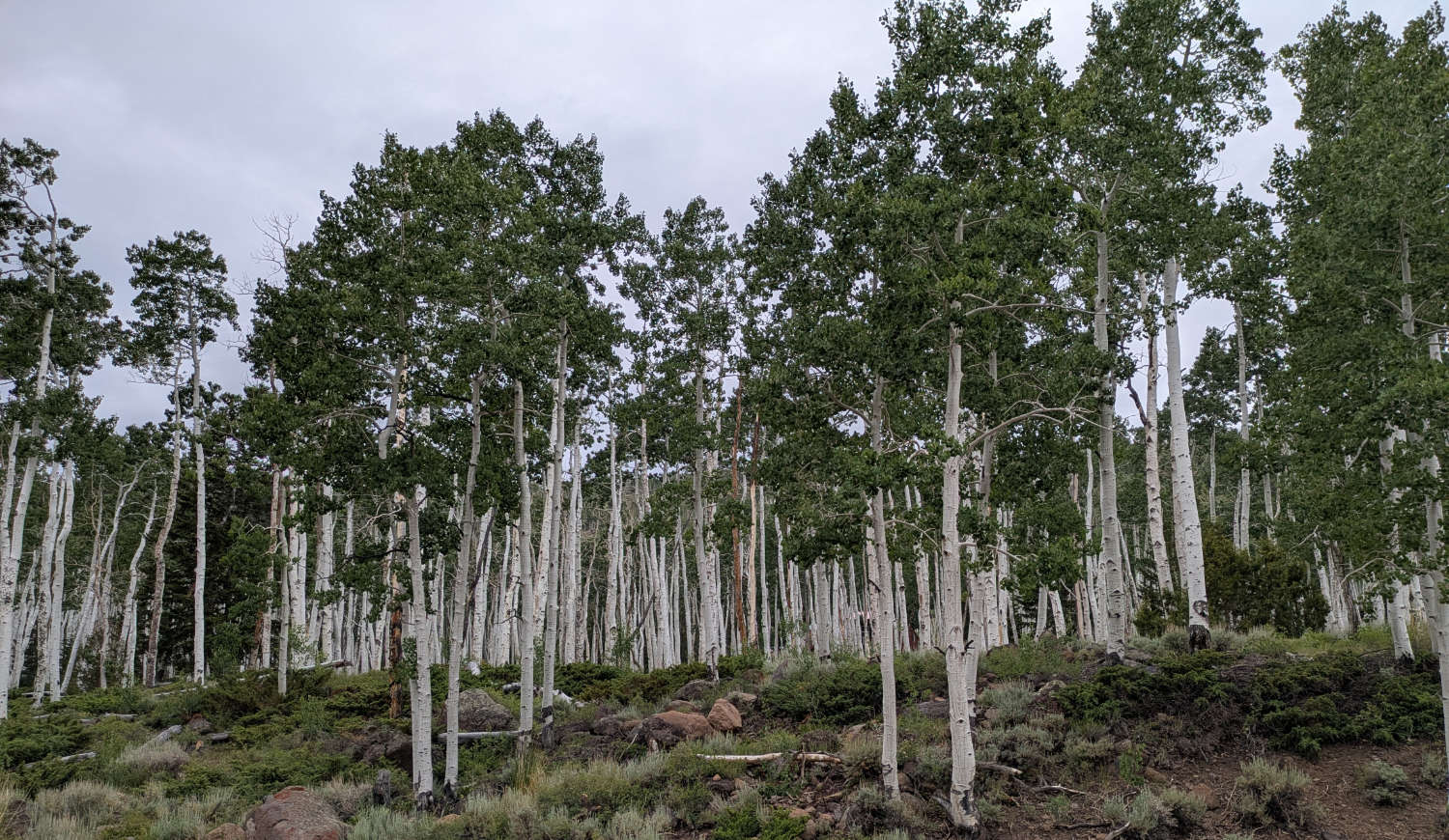
Photograph of Pando by Mx. Granger (License CC0)
Very impressive, but Pando’s “individual” trees — or perhaps they’re best called branches — only grow to little over 100 years old. A very similar isolated clonal colony of Huon pine (Lagarostrobos franklinii) can be found on the island of Tasmania where, in the absence of female tees, a single male tree has cloned itself into hundreds of genetically identical trees for at least 10,500 years! But this time, “individual” trees reach an incredible 2,000 – 3,000 years old. The info is scarce on this tree with sources vaguely stating “vegetative reproduction”, but given the tree’s weeping form and it being a conifer, the Huon pine’s tactic is probably layering, where a branch touches the ground and catches root to form a new tree from there. This form of vegetative reproduction comes very close to cuttings…
Not far away on the same island of Tasmania, the last stop brings us to a small tree — most would call it a big shrub — that can’t reproduce sexually at all. This tree takes isolation to the next level by being the very last individual of its species Lomatia tasmanica and has been surviving for many thousands of years by growing new trees from fallen branches — basically it’s been cloning itself over and over, steadily holding ground in a single grove of around 600 genetically identical trees. It may be a bit of a stretch, but if you count this grove as one single organism, it is estimated at anywhere between 43,000 to even 130,000 years old!
So there we have our answer: the oldest tree we currently know of has been reproducing for thousands upon thousands of years though cuttings! You can indeed propagate from cuttings indefinitely. This makes trees practically immortal. Trees do not age because they do not reuse their old tissue — new rings are added and new twigs are grown, but the old wood within dies over the years. So if you don’t count the dead heartwood, you could make a good case and say that even the biggest tree is no older than the innermost ring of living sapwood.
It makes you wonder though, if Old Tjikko is such an inconspicuous tree at just 5 meters, and if you can hardly tell a clonal colony apart from a regular grove, whether we will discover even older trees in the future.
Cultivars
Our tour of some of the oldest trees on earth has revealed several unconventional ways of reproduction. We can use these methods to our advantage to create more copies of trees that we like. We call these cloned trees cultivars, short for cultivated variations. They do not include the natural clones we discussed earlier, only the clones that are deliberately propagated outside of nature. Here are two examples:
- People have been selecting and propagating apple trees to get the biggest and juiciest fruit for centuries. More recently, we’ve been sticking fancy names on cultivars and even patenting them. People are weird like that.
- Lombardy poplar from Italy is a natural genetic mutation of a black poplar tree, a male clone that has been propagated through cuttings for several hundred years. It is known for its iconic tall and slender shape — very different from how poplars usually grow, and yet this is what most people picture when they think of poplars — a shape so recognizable that this cultivar has become the prime representative of its entire species. It steals the show!
Cultivating trees this way cuts out almost all genetic variation and could prove very risky, should a disease arise…
Tall trees catch the most wind
As you very well know, trees do unfortunately die all the time. If they are not cut down by people, there is a range of natural causes, with fungal infections taking the lead. The life of trees is closely tied to fungi, some are beneficial while others spell decay. Affected trees can continue to live for hundreds of years — some of the worlds tallest and most massive trees grow so fast that they keep outpacing the fungi that try to eat them from within. A winning tactic!
But then there are bacteria, viral infections and a wide range of beetles and other bugs that continue to attack the tree. And the sedentary lifestyle of trees doesn’t help either, it leaves them defensless against extreme environmental events like drought and wildfire, which are increasingly causing massive dieback in forests.
And then there’s the size of trees. The biggest strength of a tree is also its weakness. Trees just keep on growing and growing until wind and gravity can no longer be ignored. Bigger branches start to snap, leaving bigger wounds and a way in for insects and diseases. And even with no wounds, a bigger tree has more surface area that can be attacked, also by wind — windthrow is also an important cause of death of massive trees. The Dutch proverb “tall trees catch the most wind” sums it up nicely. The Lombardy poplar I mentioned earlier is a prime example of a tall tree.
And even in the most sheltered of places where trees can to grow taller than ever, there are still limits to their exponential growth. The root system needs to keep up with the above-ground tree, and when there’s no new space for roots to explore, the stagnating supply of root hormones gets diluted over the slowly expanding branches. That will eventually stop the branches from growing, and the tree will gradually die back.
Bonsai trees on the other hand are kept small year after year, and they can grow much older than their full size siblings, but only if they are cared for on a daily schedule. Growing trees like this, in a shallow pot, makes them very vulnerable, they need constant watering, regular feeding and the occasional repot every few years. A few days of neglect could spell disaster. Which makes it so impressive that bonsai trees of 500, 800 and even 1000 years old exist, and even thrive! Key to the health of a bonsai tree is to maintain a good horonal balance between the roots and the tree above.
It’s interesting to see that the oldest trees around are the ones that endure the most hardships, but sometimes it doesn’t hurt to give the tree a helping hand. Like in the way that Japanese gardeners support the side branches of their most beautiful park trees, thereby extending the life of these branches tremendously. With gravity out of the way, how old could a tree actually grow? Only time will tell.
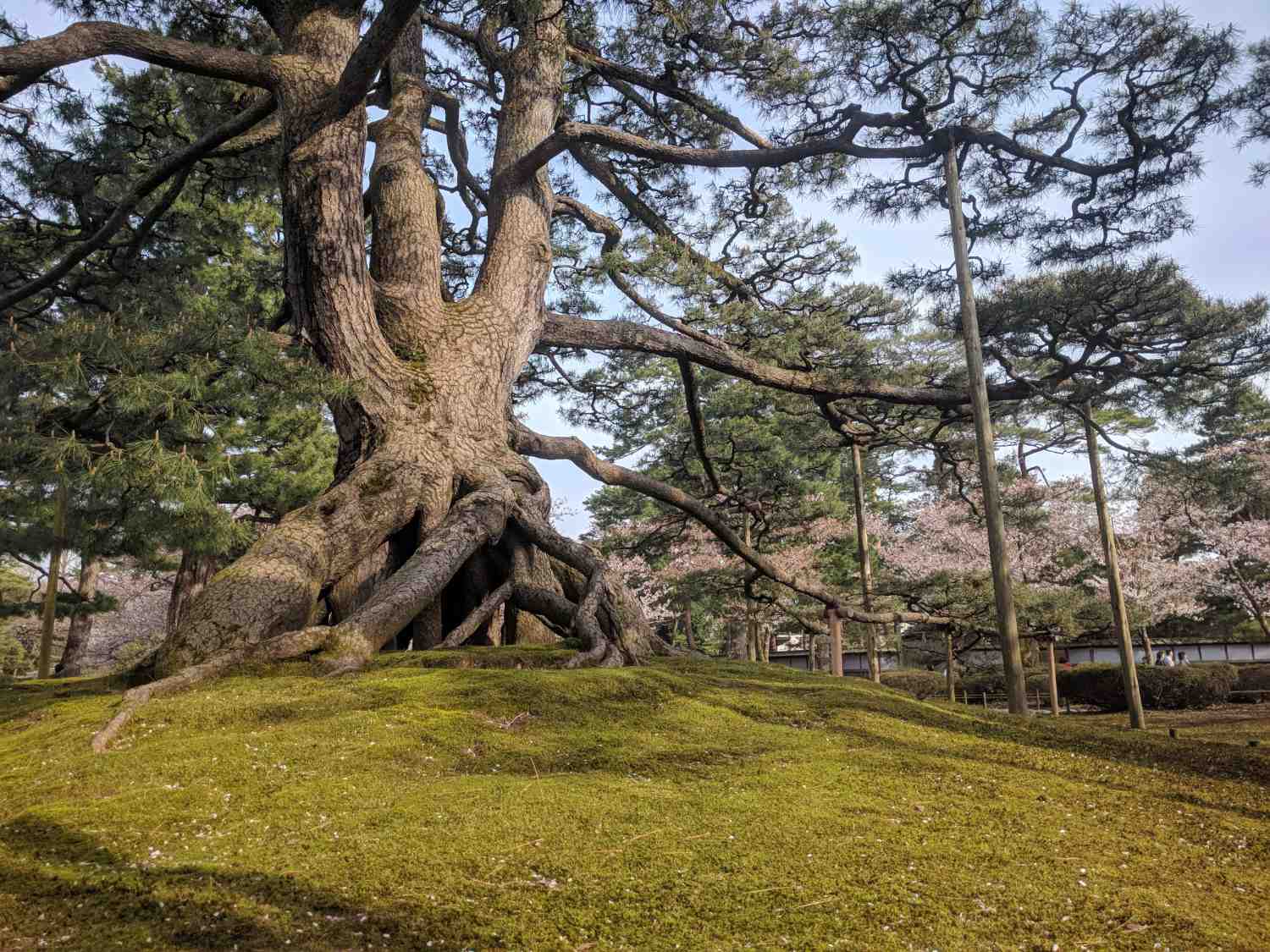
Photograph of supported pine tree in Kenroku-en garden, Japan, by SOHAFun
Further reading
- Estimating tree age is not an exact science until you cut the tree down. Read the controversial story about Prometheus, once considered the oldest tree on the planet, over on wikipedia.org.
- A much longer list of old trees can be found on wikipedia.org.
- An interesting listen on how trees bulk up once they reach their peak height over on npr.org.
- A great read on longevity of conifers in specific over on conifers.org.